Dondora Head Lighthouse
Written by the Sithiyam Travel team in Colombo
 Sri Lanka
Overview
What makes this place worth the journey.
Why people visit Dondra Head Lighthouse
Dondra Head, just outside the town of Dondra near Matara, is the southernmost point of Sri Lanka — the closest the island gets to open ocean with nothing between here and Antarctica. That single fact, more than the lighthouse itself, is what brings most people here. It is a landmark to have stood at, not a place with much to occupy an afternoon.
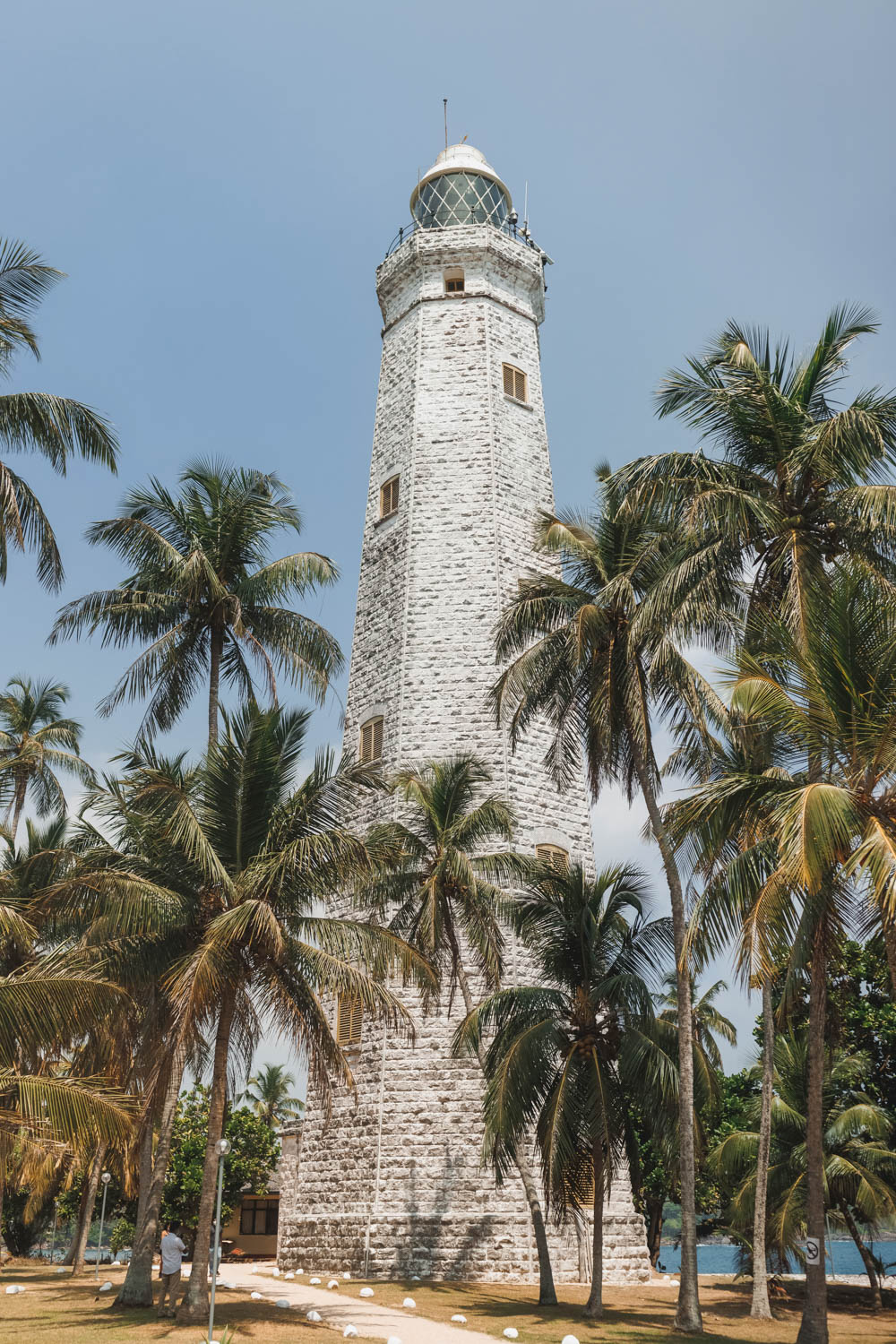
The lighthouse itself is real and still working. At around 49 metres (161 feet) it is the tallest lighthouse in Sri Lanka, built in the late 1880s by the same British engineering family responsible for several of the UK's most famous lights. The tower is an octagonal granite-and-iron structure, painted white, standing on a rocky point that takes the full force of the Indian Ocean swell.
What you'll actually find there
Most visitors arrive expecting a viewing platform or a small museum and find neither. The compound is fenced, it is run by the Sri Lanka Ports Authority as working navigation infrastructure, and reports on whether you can climb it are inconsistent — some visitors in 2026 were turned away at the gate, others say a request to the keeper on a quiet morning got them in. Do not plan a visit around getting inside; treat it as a bonus if it happens.
What you can reliably do is walk out onto the point, look at the lighthouse from outside the fence, and stand where the coastline runs out into open water. The setting is dramatic rather than pretty — a working headland with waves breaking hard against black rock, not a manicured lookout. There is little shade and few facilities.
Is it worth the detour?
Honestly: only if you are already passing through. Dondra Head is not a destination people build a day around, and reviewers who arrive expecting a "must-see" are often disappointed — some describe it flatly as a lighthouse on a rock, nothing more. But if you are driving the south coast road between Galle and Mirissa or Tangalle anyway, it costs twenty minutes and a short tuk-tuk fare to say you have stood at the southern tip of the island, and it pairs naturally with the Devinuwara temple a few hundred metres away.
The temple next door
The more historically significant site at Dondra is not the lighthouse but the Devinuwara temple complex, also called Uthpalawarna Sri Upulvan Devalaya — a multi-religious site dedicated to the god Vishnu (known locally as Upulvan) that gives the area its old name, "the City of the Gods." It sits close enough to the lighthouse to walk between the two, and for most visitors it is the more interesting stop of the pair.
Is this the same "southernmost point" people mean elsewhere?
Yes — Dondra Head, not Galle Fort and not anywhere near Yala, is the accepted southernmost point of mainland Sri Lanka. It is a genuine geographic landmark rather than a claim invented for tourists, which is part of why it keeps appearing on "what to see near Matara" lists even though there is objectively very little to do once you are there.
No beach here
A common mix-up: people expect Dondra Head to be a beach, because most of the south coast around Matara, Mirissa and Weligama is beach. It is not. The point itself is exposed rock and the sea beneath the lighthouse is rough and unsuitable for swimming. If you want the beach experience, that is a separate stop — Polhena, a sheltered reef beach on the edge of Matara town, is the nearest swimmable option, a short tuk-tuk ride away.
Crowds, touts and timing
Dondra Head sees a fraction of the visitor numbers of Galle Fort or Mirissa beach. On most days you will find a handful of tourists, a few local fishermen on the rocks, and no organised ticket booth — part of why the entrance-fee reports online contradict each other. There is little hard-selling at the site itself; the main hassle, if any, is agreeing a fair tuk-tuk fare in Matara before you set off rather than after you arrive.
Weather and sea conditions
The south coast gets its heaviest rain and roughest seas during the southwest monsoon, roughly May to September, when the surf at the point is at its most dramatic but also least safe to get close to. The calmer, drier window from December to April is more pleasant for standing on the rocks, and is also whale-watching season at nearby Mirissa.
Getting the visit in proportion
Treat Dondra Head as a fifteen-to-thirty-minute stop, not a half-day excursion. Combine it with Matara's Dutch fort and old town, with the temple next door, or fold it into a longer south-coast day that includes Mirissa for whale watching or Weligama for surfing. On its own, a special trip just to see the lighthouse is hard to justify unless lighthouses specifically interest you.
Photographing it well
The lighthouse photographs best from a short distance back, on the approach road or from the rocks to either side of the compound, where you can get the full white tower against the sky rather than a foreshortened view from directly beneath it. Late afternoon light tends to work better than the flat glare of midday, and the surf in the foreground is usually more interesting when the tide and swell are up rather than at dead calm.
A working part of the coast, not a resort
It is worth remembering that Dondra Head is not set up as a tourist attraction in the way a resort town further along the coast might be. There is no visitor centre, no gift shop, and no formal queue system — it is a functioning navigation light next to a fishing community and an old temple, and visitors are essentially guests passing through someone else's working coastline. That is part of why the experience feels thin compared with the marketing photos: what you are looking at is infrastructure and geography, not an attraction built for tourists, and going in with that expectation makes the short visit feel honest rather than disappointing.
Is it worth it?
Including who should skip it.
What to do
What the visit is actually made of.
What to look for
- The octagonal tower — granite at the base, iron above, all painted white, a distinctive shape against the sky.
- The light itself — still an active aid to navigation for ships rounding the island.
- The rock platform — the point where the land visibly runs out into open ocean.
- The keeper's quarters and outbuildings — colonial-era structures around the base of the tower.
Why come here
The reasons travellers book around this place.
History of Dondra Head Lighthouse
Construction began in November 1887 and the lighthouse was completed around 1889, under Sri Lanka's British-era Imperial Lighthouse Service. It was designed by Sir James Nicholas Douglass — part of the Douglass family responsible for several of Britain's best-known lighthouses — and built by William Douglass. The tower is granite at the base and iron above, most of the material shipped in from the United Kingdom, assembled on the point, and painted white.
Dondra Head sits at the tip of a peninsula that mattered to sailors long before the lighthouse existed. Ships rounding the southern tip of Sri Lanka on the old trade routes between Europe and the Far East used the headland as a landmark, and the surrounding area — Devinuwara, "City of the Gods" — was already an important pilgrimage and temple site for centuries before the British arrived.
Today the lighthouse is still a working aid to navigation, maintained by the Sri Lanka Ports Authority rather than kept as a museum piece — which is also part of why access to the tower itself is restricted.
Hiraz's take
Getting here
Every realistic way in, with times and fares.
Getting to Dondra Head
From Matara town: about 6 km, roughly 15–20 minutes by tuk-tuk. Fares are unmetered — agree a price before you set off; round trips including waiting time have been reported around LKR 600–1,000.
From Mirissa: about 18 km, roughly 30–35 minutes by tuk-tuk or car, making it an easy add-on to a day built around whale watching.
From Galle: about 65 km, around 1.5 hours by road.
From Colombo: around 160 km, 3–3.5 hours by car via the Southern Expressway to Matara, then local roads.
There is no rail station at Dondra itself; the nearest stop on the coastal line is Matara, the southern terminus of the railway.
Travel tips
The small things nobody tells you until you are there.
- Closed, sturdy footwear for uneven rock
- Sun hat and sunscreen — no shade at the point
- Small cash for tuk-tuk fare and a possible entrance fee
- Water — no shops directly at the site
- A driver or tuk-tuk arranged with a return time, since taxis do not wait around at the point
Local tips
✔️ Combine it with the Devinuwara temple next door — most people find the temple more rewarding than the lighthouse.
✔️ Agree your tuk-tuk fare, including waiting time, before you leave Matara.
✔️ Go early or late in the day — there is no shade and the midday sun on open rock is intense.
✔️ Do not expect to climb the tower — treat it as a possible bonus, not the plan.
✔️ Bring cash in small notes in case there is an entrance charge on the day.
✔️ Pair it with Matara's Dutch fort and old town rather than visiting on its own.
✔️ If whale watching from Mirissa, add Dondra Head onto the same morning rather than a separate trip.
When to go
The dry, bright window and the months to sit out.
What to actually do at Dondra Head
- Walk out to the point — the lighthouse and the rocks beneath it are a five-minute walk from where vehicles park.
- Photograph the tower from outside the compound fence — the realistic outcome for most visitors, rather than going inside.
- Watch the surf — the swell hitting the exposed rock is the most dramatic thing to see here, especially outside the calmest months.
- Walk to Devinuwara temple — a few hundred metres away, and worth more of your time than the lighthouse itself.
- Ask locally about climbing access — if the gate is open and someone is willing to let you up, it is worth taking, but do not build your visit around it.
Allow 20–30 minutes at the lighthouse itself.
Pair it with
Worth combining into the same day.
.jpeg)

On our routes
In frames
A closer look, frame by frame.
Where to stay
Places we actually put people, at three budgets.
.jpeg)
Common questions
Taken from what people actually search for.
Is Dondra Head the southernmost point of Sri Lanka?
Yes. Dondra Head, near the town of Dondra by Matara, is the accepted southernmost point of mainland Sri Lanka, with open ocean stretching south toward Antarctica.
How tall is Dondra Head Lighthouse?
It stands at around 49 metres (161 feet), making it the tallest lighthouse in Sri Lanka.
Can you climb Dondra Head Lighthouse?
It depends on the day. Some visitors are allowed up the roughly 196 steps with permission from the keeper; others are turned away at the gate. Do not plan your visit assuming you will get inside.
Is there an entrance fee?
Reports conflict — some visitors pay a small fee, around LKR 100–300, and others are charged nothing.
How do you get to Dondra Head from Matara?
It is about 6 km from Matara town, roughly 15–20 minutes by tuk-tuk; agree the fare, including any waiting time, before you set off.
Is there a beach at Dondra Head?
No. The point is exposed rock with rough surf, not a swimming beach — the nearest sheltered swimming spot is Polhena Beach on the edge of Matara.
How long do you need at Dondra Head?
About 20–30 minutes for the lighthouse itself; add the Devinuwara temple next door and you can comfortably fill 45 minutes to an hour.
Sources and last checked
Make it yours.
Tell us what pulls at you and we'll thread this journey into one private itinerary — sent back on a live link within 24 hours.
Visit Dondra Head with Sithiyam
We build private south-coast routes that treat Dondra Head as what it is: a short, worthwhile stop, not a full day. Your driver-guide can time it alongside Matara's Dutch fort, the Devinuwara temple, and whale watching or a beach stop in Mirissa, so you see the southernmost point of Sri Lanka without losing half a day to it. Message us on WhatsApp to talk through where it fits in your south coast plan.